Bingo · About the game
Bingo: find your numbers and complete a line
As the host draws numbers, find and mark them on your own board. Complete a horizontal, vertical or diagonal line, then claim Bingo.
See the game screens
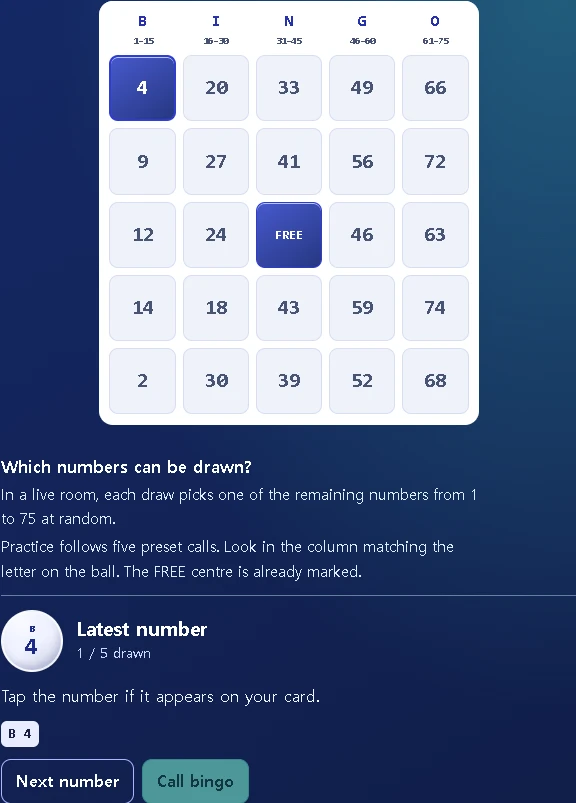
Practice screenView full-size screenshot
- Find the drawn number on your card and mark it.
- Check the latest number and how many numbers have been drawn.
Shared numbers, individual boards
Each player receives a personal board. The host announces the shared draws, and everyone checks their own numbers as the game unfolds.
Start together without a question bank
Use Bingo for a family gathering, a break or a casual group activity. The focus is on finding drawn numbers and completing a line, rather than recalling a quiz answer quickly.
Give the group a shared draw screen
The host checks the roster and draws numbers one at a time. A shared display can show the latest number and draw history while players use personal devices for their boards.
Practise marking and claiming with an example
The home-page solo practice uses a fixed sample board and number sequence. It teaches the controls; it is not a real draw or an indication of winning odds.
Read a bingo card before the first draw
B covers 1–15, I covers 16–30, N covers 31–45, G covers 46–60 and O covers 61–75. Call the letter first so people can find the column on a small screen. The centre FREE space already counts.
Read next
Ready to play together?
Hosts can create a game. Invited players can enter their code on the game home page.
Go to game home